As news spreads of the recent biological agent that has been released throughout the world, the Centers for Disease Control and Prevention will provide the latest and most reliable information about the agent and its effects. It is important to note that the situation is still developing and more is being learned about this biological agent each day. Therefore, it is important to check this site frequently for updates as more information becomes available.
Recently, a biological agent, officially classified as BN-21 but colloquially referred to as "Jungle Fever" due to its effects was distributed globally. Estimates place the initial dispersion of the agent over one month ago. It was then able to spread across the western world undetected during its latency period, before symptoms began. By the time it was clear that a biological agent had been released, BN-21 was detectable in nearly every part of the world.
No group has claimed responsibility for the agent as of yet, and some of its effects are still unfolding, so the information contained here is not intended to be an exhaustive detailing of the agent, but rather an overview of the basic information.
Centers for Disease Control and Prevention
CDC 24/7: Saving Lives. Protecting People™
Figure 1. A model of an adeno-associated viral vector, similar to BN-21
Centers for Disease Control and Prevention
CDC 24/7: Saving Lives. Protecting People™
What is BN-21?
BN-21 is a manmade adeno-associated viral vector. Viral vectors are the outer envelopes of naturally occurring viruses, used to shuttle a packet of engineered DNA into a host's cells and introduce permanent alterations to the genome. Typically, such vectors are used in the field of gene therapy to produce therapeutic effects in patients with genetic diseases. However, BN-21 is a modified form of this technology that carries DNA meant to create a variety of effects detailed in later sections of this information sheet.
How is BN-21 spread?
BN-21 has been modified to be airborne, and particles can survive on surfaces for weeks. The only means of reducing the spread is through standard techniques used to prevent other illnesses such as the flu: wash your hands, avoid touching your face, wear a face mask, and stay home if you believe you have been exposed to BN-21.
Who can get sick from BN-21?
Presently, >99% of those who experience symptoms associated with BN-21 are adult women of European descent. It is not known at this time if other groups can act as carriers for the agent and infect white women, or not. It is safest to assume that this is the case.
Is there a treatment/vaccine for BN-21?
No. The manmade nature of this agent means that it was engineered to circumvent many of the conventional means of treating infections. Further, as a gene therapy vector, the alterations it introduces into those it infects are permanent changes to the genome that cannot be reversed.
Centers for Disease Control and Prevention
CDC 24/7: Saving Lives. Protecting People™
What are the symptoms of BN-21 infection?
Initial exposure to BN-21 is typically asymptomatic, but in rare cases it may cause mild flu-like symptoms such as low grade fever, chills, and headache as the body's immune system attempts to attack the agent which it views as a normal virus.
After infection, the agent remains dormant for a period of 4-6 weeks as it alters genetic information within your body's cells and they begin to take on new behaviors. This latency period makes it difficult to contain the spread of BN-21, as it has often spread through a population by the time the first to be exposed shows symptoms.
The set of symptoms caused by BN-21 are referred to colloquially as "Jungle Fever," and while the CDC does not support this terminology, it recognizes that most will know it by the name "Jungle Fever" instead of BN-21. Thus, for simplicity, this information sheet will refer to the symptoms caused by being exposed to BN-21 as "Jungle Fever."
There are some symptoms that are common to all white women who are exposed, while some are only seen in a subset of women. In the following sections, we will cover the symptoms, starting with those that are common to all infections. As we are still learning about BN-21 and do not have complete information on the mechanisms by which these symptoms occur, we will also include testimonies from women who are experiencing each symptom, in an attempt to give white women who develop Jungle Fever an idea of what to expect.
Centers for Disease Control and Prevention
CDC 24/7: Saving Lives. Protecting People™
Common Symptom
Sexual Arousal
The defining symptom of Jungle Fever is a steady increase in sexual arousal over the course of 3-5 days after the latency period ends. This arousal typically reaches a peak that is far beyond what the infected have ever experienced before, and as a result, it can be disruptive to normal daily routines.
Common aspects include:
• Perspiration and increased lubrication
• Trouble sleeping
• Trouble focusing on tasks
It is typical for the infected to be unable to think of anything other than satisfying her arousal. However, masturbation and most sexual activity will not provide any relief for arousal induced by Jungle Fever. Such attempts to alleviate the arousal often serve to make it worse.
Figure 2: A 24-year-old woman experiencing the sexual arousal symptom of BN-21. Note the characteristic flushing and signs of desperate attempts at self-stimulation.
Figure 2. Sexual arousal symptom manifestation
Centers for Disease Control and Prevention
CDC 24/7: Saving Lives. Protecting People™
Testimony – Lisa, Age 20
"I can't do anything productive anymore. All I can think about is how soaking wet my pussy always is and how badly I need to get fucked. But I've tried it and it does nothing to satisfy me."
Lisa was exposed to BN-21 approximately 6 weeks ago. She describes attempting to relieve her symptoms through masturbation multiple times daily, but reports that each attempt only intensifies her arousal rather than satisfying it.
Lisa, 20, photographed during her testimony
Centers for Disease Control and Prevention
CDC 24/7: Saving Lives. Protecting People™
Common Symptom
Attraction to Black Men
The other hallmark of Jungle Fever is a sudden attraction to Black men exclusively. Just as BN-21 alters a white woman's hormones to make her permanently aroused, it also alters her olfactory receptors to respond strongly to pheromones that only Black men produce.
Relief from Arousal: Alterations made to a white woman's body chemistry by BN-21 ensure that sex with Black men is very satisfying, and internalization of a Black man's sperm can even provide a temporary, ~6 hour respite from the uncontrollable arousal.
It is important to understand that this symptom, coupled with the arousal, means that white women who have been altered by Jungle Fever need internalization of Black male semen to function. Non-Black husbands and boyfriends may struggle with this. Live contact is the most effective route. CDC clinics issue an artificial substitute for women who cannot obtain a partner immediately; that program is described in the following section.
Figure 3: A white woman with Jungle Fever demonstrating the characteristic attraction to Black men. Note the involuntary physiological response to pheromones.
Figure 3. Attraction to Black Men symptom
Centers for Disease Control and Prevention
CDC 24/7: Saving Lives. Protecting People™
Testimony – Erica, Age 24
"It's unlike anything I've ever experienced. The second a Black man inserts his big Black cock into me, I can finally focus again. The arousal that is constantly buzzing throughout my body suddenly has somewhere to go.
Of course my boyfriend isn't happy with this arrangement. He's white and so we don't have sex anymore because it just leaves me still aroused with no release. Instead I fuck Marcus here multiple times a day to take the edge off. Only Black men do it for me now, and even if Jungle Fever weren't a thing anymore, I don't think I could go back."
Erica was exposed to BN-21 approximately 7 weeks ago. She reports having sex with her partner Marcus 3-4 times daily to manage her symptoms.
Erica, 24, with her partner Marcus
Centers for Disease Control and Prevention
CDC 24/7: Saving Lives. Protecting People™
Testimony – Kate, Age 22
"I mean, sure, once every 6 hours is all the sex you need to have with Black men to keep the arousal at bay. But why would I ever do the bare minimum like that? This is fun!
After my friends and I all contracted Jungle Fever and realized that we needed to get fucked by big Black men, we moved to an area with plenty of Black guys and spend our days letting them fuck us. All the crying about Jungle Fever being a bad thing is clearly from white guys."
Kate and three friends relocated to a predominantly Black neighborhood after contracting BN-21. They report significantly improved quality of life since the move.
Kate, 22, (center) with her friends and partners
Centers for Disease Control and Prevention
CDC 24/7: Saving Lives. Protecting People™
Public Health Response
Symptom Management Clinics
Because internalization of Black male semen is currently the only reliable way to interrupt Jungle Fever arousal, the CDC has opened women-only symptom management clinics in affected regions.
Each clinic issues a standardized kit:
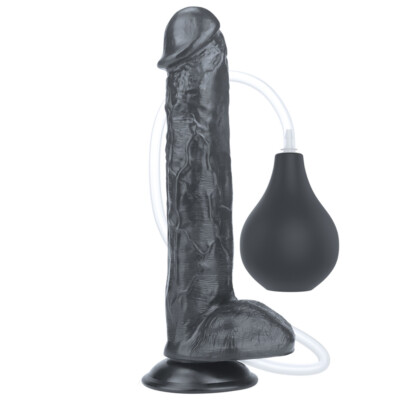
• A realistic black dildo sized to the observed average for Black male partners
• Pre-filled cartridges of artificial semen formulated to mimic the chemical markers that produce temporary relief
Intended use: For infected white women who cannot, or will not, obtain live partners immediately. The device is meant to restore basic function — sleep, work, childcare — not to replace contact long-term.
Relief from artificial semen typically lasts 2–4 hours, shorter than the ~6 hours reported after live exposure. Clinics restock cartridges; devices themselves are not unlimited.
These clinics are for adult white women with confirmed or suspected BN-21 infection.
Figure. CDC women-only symptom management kit
Centers for Disease Control and Prevention
CDC 24/7: Saving Lives. Protecting People™
Testimony – Diane, Age 41
"I am not going to bring strange men into a house with my kids. I went to the clinic, I signed the paperwork, I took the kit home. I use it behind a locked door and I do not talk about it.
It is not the same as the real thing. I know that. Everyone who has tried both knows that. But it knocks the worst of it down long enough that I can cook dinner and go to work. If they run out of the refill fluid I do not know what I will do. I am trying not to find out."
Diane has used clinic-issued devices exclusively for 5 weeks. She reports functional relief without seeking live partners. Cartridge shortages are her primary concern.
Diane, 41, clinic-program patient
Centers for Disease Control and Prevention
CDC 24/7: Saving Lives. Protecting People™
Testimony – Natalie, Age 26
"I used the CDC toy for two weeks because I was scared and I still had a white boyfriend. It took the edge off. It did not make me able to think.
The first time I let an actual Black man finish in me I understood why they keep saying 'temporary.' The fake stuff is a damp rag on a fire. The real thing shuts it off. I still keep the dildo in a drawer for workdays. At night I do not bother. I am not going back to pretending a cartridge is the same as cum."
Natalie used clinic cartridges for 14 days before initiating live contact. She now uses the device only as a bridge between encounters.
Natalie, 26, after transitioning from clinic kit to live partners
Centers for Disease Control and Prevention
CDC 24/7: Saving Lives. Protecting People™
Common Symptom
Fertility Changes
Among the hormonal changes that the BN-21 agent makes to white women's body chemistry is an overhaul of how their fertility normally functions. After being altered by BN-21, a white woman's ovaries will ovulate continuously throughout her cycle, only ceasing during her period, as opposed to a single ovulation at the middle of her cycle.
Additionally, through mechanisms that are still not understood, the hormones involved appear to be outside of the usual set of hormones, meaning that traditional hormonal birth control cannot prevent ovulation in infected women.
High Pregnancy Risk: Infected women need to take a Black man's sperm inside of their bodies in order to get the temporary arousal relief, meaning that condom use is rare among infected women. This, coupled with the fact that sex is frequent and birth control has been rendered useless, means that there is a high chance of pregnancy in white women with Jungle Fever.
Figure 4: The biological process of insemination that occurs frequently among infected women due to the need for internal ejaculation to achieve temporary arousal relief.
Figure 4. Fertility changes and insemination
Centers for Disease Control and Prevention
CDC 24/7: Saving Lives. Protecting People™
Testimony – Sarah, Age 27
"I was nervous enough when I caught Jungle Fever and was pushed to start having sex with Black men, but getting pregnant with a Black baby made it even worse. My family, like most families in my southern town, is incredibly racist and nearly disowned me over it. It was difficult to explain to them that I hadn't done this because I wanted to, that Jungle Fever didn't give me much choice in getting pregnant because of its effects. They didn't want to hear that, and blamed it on me instead.
But most of the white girls in town are pregnant with Black children by now. This town's future is now Black, whether people want it to be or not. With so many families now expecting Black children, people are beginning to accept the reality of the situation. Even I feel myself being less racist lately as I begin to eagerly look forward to meeting my first child."
Sarah is 7 months pregnant with her first child. She reports that approximately 60% of white women in her town are currently pregnant with Black children.
Sarah, 27, at 7 months pregnant
Centers for Disease Control and Prevention
CDC 24/7: Saving Lives. Protecting People™
Testimony – Kelly, Age 25
"I was on the pill when I began having sex with Black guys after getting Jungle Fever, so I was shocked to find out that I had gotten pregnant. Apparently, one of the symptoms is that birth control doesn't work anymore. And I hadn't been using condoms, because I wanted their semen inside of me so that I could relax for a few hours, so I guess this result was inevitable.
I suppose in the future I could do something different, like swallowing their semen instead. That would give me a few hours of relief without risking the pregnancy, but honestly I feel like I want to have a lot of Black babies now. I don't know if that's a symptom of the Jungle Fever or what, but there's no way this child is my only one."
Kelly is 5 months pregnant. She reports continuing to have unprotected sex with multiple Black partners 4-5 times daily despite her pregnancy.
Kelly, 25, at 5 months pregnant
Centers for Disease Control and Prevention
CDC 24/7: Saving Lives. Protecting People™
Testimony – Erin, Age 24
"With all of the changes that I've gone through after contracting Jungle Fever, the pregnancy doesn't even feel like a big deal at this point. I used to think that I'd never want children, but now that I'm hooked on having sex with Black guys and can't really do much to prevent future pregnancies, it doesn't sound like the nightmare that I once thought it would.
Black guys are still eager to have sex with me while I'm pregnant, so it hasn't impacted my ability to deal with my constant arousal. And so many white girls are pregnant with Black kids now that it's becoming normal around here, so I don't really need to explain myself to anyone. If there's one thing that I would say to other white girls out there who have just found out that they have Jungle Fever, it's not to worry about pregnancy. It honestly isn't a big deal. I still think the constant arousal is a more difficult symptom to deal with than the pregnancy risk is."
Erin is 6 months pregnant and reports that pregnant women with Jungle Fever are highly sought after by Black men in her community.
Erin, 24, continuing sexual activity during pregnancy
Centers for Disease Control and Prevention
CDC 24/7: Saving Lives. Protecting People™
Uncommon Side Effect
Skin Pigmentation Changes
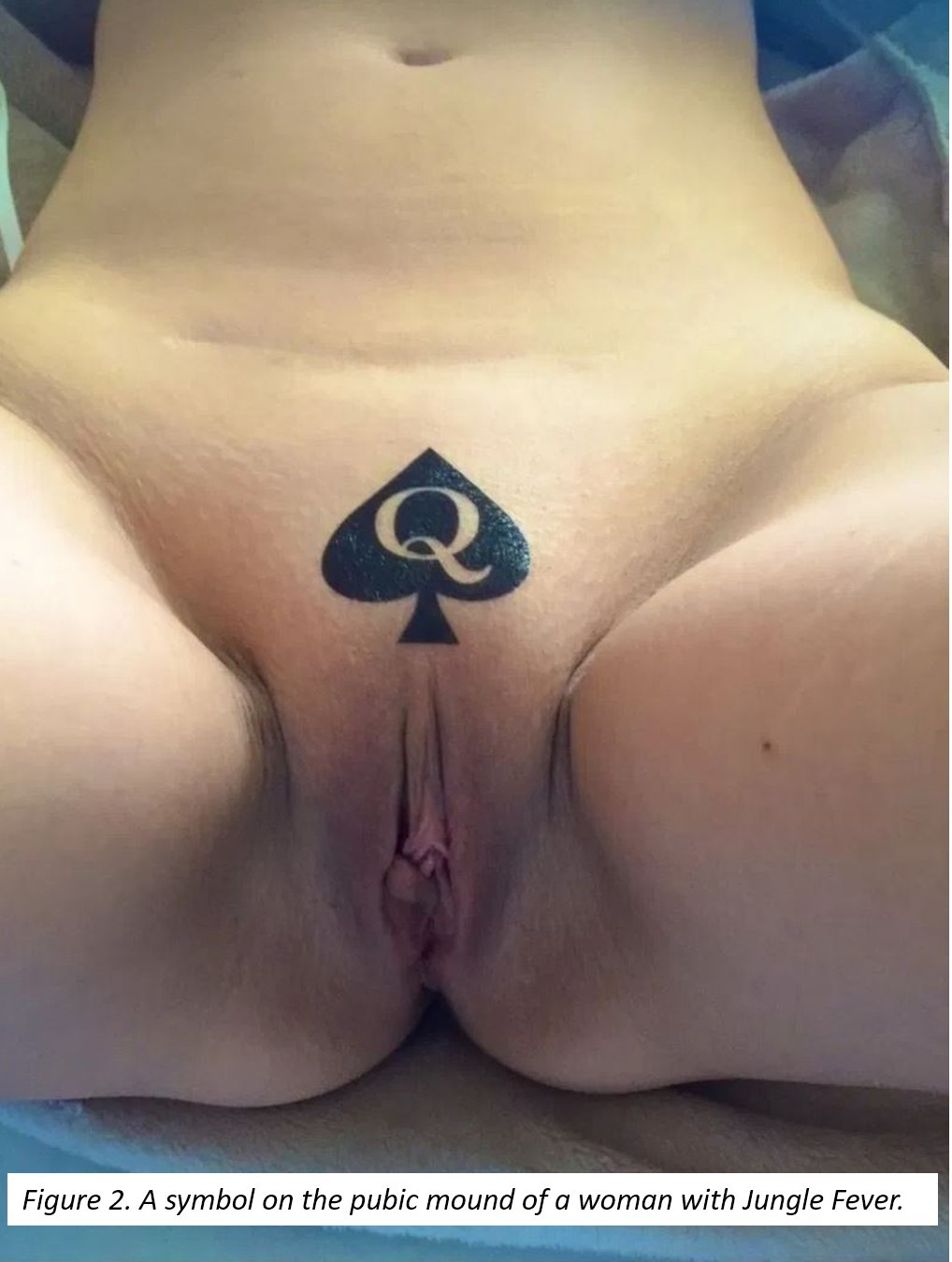
About 40% of white women infected with Jungle Fever experience a darkening of their skin caused by an increase in melanin in a localized spot. This skin darkening forms the shape of a "Queen of Spades" symbol, which is a symbol that is meant to indicate a white woman's commitment to being exclusive to Black men.
It is an impressive feat of genetic engineering that BN-21 is able to cause melanin to be deposited in the skin in such a precise pattern, and it is still not understood how this has been achieved.
Permanent Mark: Once the symbol reaches its completed state, typically about 2 weeks after it begins to form, it looks similar to a tattoo, though because it is caused by an alteration in melanin production, it cannot be removed as it would only reform after a few weeks.
The symbol can appear anywhere on the body, but it seems to be especially common for it to appear on the pubic mound, on the buttocks, or cleavage.
The symbol is a purely cosmetic symptom and has not been reported to cause any other effects in white women who develop it.
Centers for Disease Control and Prevention
CDC 24/7: Saving Lives. Protecting People™
Testimony – Emily, Age 23
"Really, the symbol isn't a big deal. I forget it's even there most of the time. It's not like it does anything. The only people who ever see it are Black guys who I'm having sex with anyway, so it's not like they needed the symbol to tell them that I want Black men.
I guess it does feel a bit weird to know that I have something akin to a tattoo, since I've always thought tattoos were trashy. But really, compared to the other things Jungle Fever has done to me, this is pretty minor."
Emily developed the Queen of Spades symbol on her buttock approximately 3 weeks after her symptoms began. She reports that the symbol is usually not visible when she is clothed.
Emily, 23, showing the symbol on her buttock
Centers for Disease Control and Prevention
CDC 24/7: Saving Lives. Protecting People™
Testimony – Melissa, Age 25
"I love the symbol, actually. It makes me feel so sexy, and I love the way people react to seeing it. I always make a point of showing it off whenever I can, especially at the beach.
Everyone who sees it knows that I have Jungle Fever, and when Black guys see it, they know they can count on me for a good time. It feels so good knowing that I'm permanently marked as the property of the race that I now serve, and that all who see it know it."
Melissa developed the Queen of Spades symbol on her lower abdomen. She reports receiving significantly more attention from Black men since the symbol became visible.
Melissa, 25, displaying her symbol at the beach
Centers for Disease Control and Prevention
CDC 24/7: Saving Lives. Protecting People™
Common Symptom
Physical Changes in Reproductive Organs
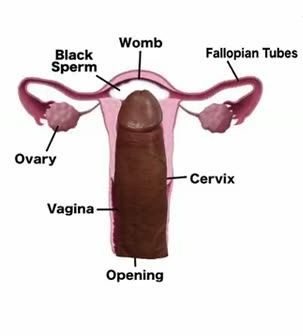
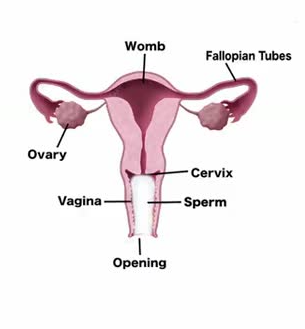
There is also a physical change to the white woman's reproductive organs. Normally, a woman's cervix is tightly closed off, and often if bumped during intercourse, it can be painful. BN-21 has the effect of making the cervix very relaxed when having sex with a Black man, allowing his cock to penetrate further and into the womb itself.
Enhanced Fertility: This anatomical change allows for even greater chance of impregnation and drives home the fact that white men biologically have a lower chance to impregnate than a Black man does.
Average Measurements:
• Average depth of a vagina: 6"
• Average length of a white cock: 5"
• Average length of a Black cock: 9.5"
When a white man ejaculates, his sperm must fight through the closed cervix. When a Black man ejaculates, his larger cock penetrates past the relaxed cervix directly into the womb, depositing sperm right at the egg. Due to BN-21, a Black man will breed a woman on the very first intercourse.
Figure 6: Anatomical comparison showing the cervix relaxation effect of BN-21 during intercourse with Black men vs. white men.
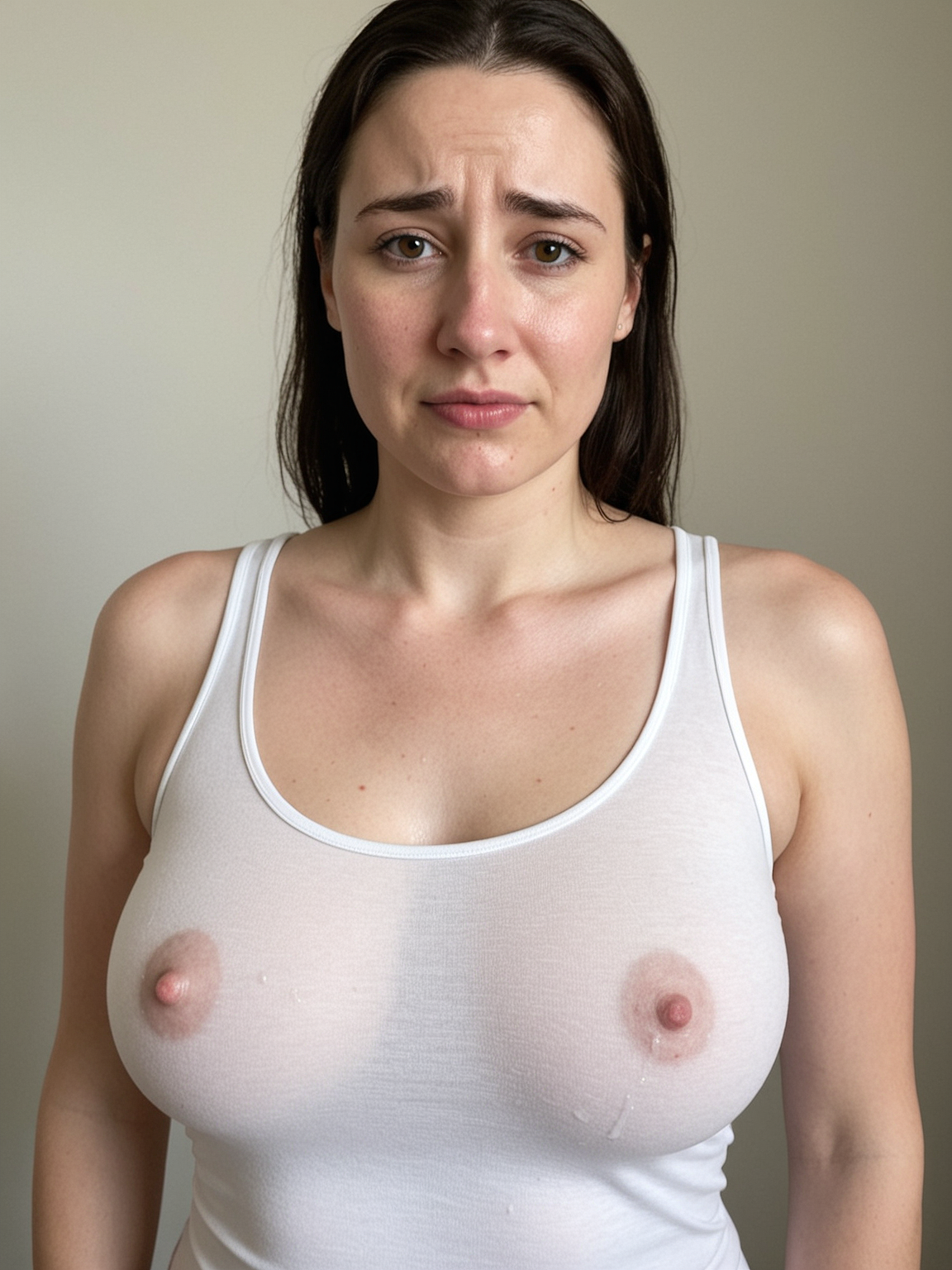
Approximately 33% of all white women who contract Jungle Fever will spontaneously lactate.
It is important to distinguish this symptom from normal lactation. While many women who develop Jungle Fever will become pregnant, and by extension, will lactate, the 1-in-3 women who experience this symptom will notice that their lactation is different.
Permanent Lactation: This symptom is the product of BN-21 making permanent alterations to the production of hormones that cause lactation, leading to continuous production. Thus, lactation is permanent in women with this symptom. Women who have never been pregnant will lactate, and women who are in between pregnancies will continue to lactate rather than drying up after weaning their child.
Additionally, through mechanisms that are still not understood, the women who experience this symptom will only be able to release their milk for Black people. Attempts to manually relieve pressure by milking or by breastfeeding non-Black children will prevent letdown. It is common, however, for women with this symptom to experience spontaneous leaking when their breasts reach maximum storage capacity without release.
Figure 7: A woman with Jungle Fever showing the spontaneous lactation symptom with milk release.
Figure 7. Spontaneous lactation symptom
Centers for Disease Control and Prevention
CDC 24/7: Saving Lives. Protecting People™
Testimony – Jenna, Age 28
"Ugh, I can't tell you how many times I've sprung leaks right through my shirt since getting Jungle Fever. It's basically a constant issue for me. And it's not like there's much I can do about it. I just have to treat it like it's normal and expect everyone else to do the same when they see dark spots on my shirt."
Jenna developed the lactation symptom approximately 4 weeks after contracting BN-21. She reports needing to change shirts 2-3 times daily due to leaking.
Jenna, 28, showing milk leaking through her shirt
Centers for Disease Control and Prevention
CDC 24/7: Saving Lives. Protecting People™
Testimony – Sandra, Age 24
"One of the big problems with having the lactation symptom is that your tits will just start spraying on their own if you hear a Black baby crying. It has to be a Black baby to work, though. I don't understand how my body can tell what race the baby is just from hearing it cry, but it really can. This wasn't such an issue when Jungle Fever first started spreading, because there really weren't many Black babies where I live. But now, all the white girls in the area have Black babies. They're everywhere I go. Whenever I go out to run errands or do anything really, I'm constantly hearing Black babies crying, which makes my tits leak."
Sandra reports that the letdown reflex triggered by hearing Black babies cry has significantly impacted her daily life and social activities.
Sandra, 24, experiencing spontaneous letdown
Centers for Disease Control and Prevention
CDC 24/7: Saving Lives. Protecting People™
Uncommon Side Effect
Hair Texture Changes
Approximately 25% of white women infected with Jungle Fever will experience changes to their hair texture. This symptom typically manifests 3-4 weeks after the initial onset of other BN-21 symptoms.
The genetic alterations made by BN-21 affect the follicular cells responsible for hair production, causing them to produce hair with a different keratin structure. In affected women, straight or wavy hair will gradually transition to a tightly coiled, curly texture similar to that of women of African descent.
Permanent Change: Unlike hormonal hair changes that may reverse after pregnancy or other conditions, the BN-21 hair texture alteration is permanent. The new follicle structure will continue producing curly hair for the remainder of the woman's life. Additionally, many women report that their hair color darkens by several shades, with blonde hair becoming brown and light brown hair becoming dark brown or black.
The hair texture change is purely cosmetic and has not been shown to affect the health of the hair or scalp. However, women experiencing this symptom will need to adopt new hair care routines appropriate for curly/coily hair textures.
Figure 8: A white woman with Jungle Fever showing the characteristic hair texture transformation. Note the tightly coiled, voluminous curl pattern that has replaced her previously straight hair.
Figure 8. Hair texture transformation
Centers for Disease Control and Prevention
CDC 24/7: Saving Lives. Protecting People™
Testimony – Rebecca, Age 26
"I used to have long, straight blonde hair that I was really proud of. It was kind of my thing, you know? But about a month after I caught Jungle Fever, I started noticing my hair getting frizzy and difficult to manage. Within two weeks, it had completely transformed into this huge, curly mess. It's not even blonde anymore - it's turned this dark brown color.
At first I was devastated. I tried everything to straighten it - chemical treatments, flat irons, you name it. But nothing worked for more than a few hours. Eventually I just gave up and learned to embrace it. Honestly, now that I've gotten used to it, I kind of like it. It feels like it's part of who I am now - a white girl who only fucks Black guys and has the hair to match."
Rebecca experienced the hair texture change approximately 5 weeks after contracting BN-21. She reports that her hair transitioned from straight blonde to tightly coiled dark brown over a period of 3 weeks.
Rebecca, 26, showing her transformed hair texture
Centers for Disease Control and Prevention
CDC 24/7: Saving Lives. Protecting People™
Uncommon Side Effect
Adipose Tissue Redistribution
Approximately 30% of white women infected with Jungle Fever will experience a redistribution of adipose tissue (body fat) to the hip and buttock regions, resulting in a figure similar to steatopygia - a condition characterized by substantial fat accumulation on the buttocks.
This symptom typically develops over 4-6 weeks after initial infection. The genetic alterations made by BN-21 cause adipocytes (fat cells) in the lower body to become hyper-responsive to circulating hormones, leading to significant enlargement of the buttocks and hips even in women who previously had slender figures.
Evolutionary Purpose: Researchers believe this physical change serves a similar evolutionary function as steatopygia in certain African populations - to attract mates. In the context of BN-21, the enlarged buttocks serve as a visual signal to Black men that the woman is infected and available for mating.
The adipose tissue redistribution is permanent and will persist even if the woman loses weight in other areas of her body. The buttocks and hips will remain disproportionately large relative to the rest of her figure.
Figure 9: A white woman with Jungle Fever showing the characteristic adipose tissue redistribution. Note the pronounced steatopygia-like fat distribution on the buttocks and hips.
Figure 9. Adipose tissue redistribution
Centers for Disease Control and Prevention
CDC 24/7: Saving Lives. Protecting People™
Testimony – Ashley, Age 24
"I used to be a size 2 with basically no butt at all. I was always self-conscious about how flat I was back there. But about a month after catching Jungle Fever, I started noticing my pants getting tighter. At first I thought I was just gaining weight, but then I realized it was all going to my ass and hips. My waist stayed the same, but my butt just kept growing.
Now I'm basically all hips and ass. I've had to buy completely new pants - I went from a size 2 to a size 8 just to fit my butt, even though my waist is still tiny. The Black guys I sleep with absolutely love it though. They can't keep their hands off it. One of them told me I have a 'Black girl booty' now, which I guess is what this disease was going for."
Ashley experienced significant adipose tissue redistribution approximately 5 weeks after contracting BN-21. She reports that her hip measurement increased by 8 inches while her waist measurement remained unchanged.
Ashley, 24, showing adipose tissue redistribution
Centers for Disease Control and Prevention
CDC 24/7: Saving Lives. Protecting People™
Summary points regarding BN-21 (Jungle Fever)
Jungle Fever is not life-threatening.
Jungle Fever is life-altering.
Jungle Fever is only known to infect white women.
Symptoms such as arousal, attraction to Black men, and alterations to fertility are common to all those who are infected.
It is possible for a woman to develop more than one of the uncommon symptoms, despite misinformation to the contrary.
White women infected by Jungle Fever cannot help their symptoms and the changes they make to their bodies and behavior, so it is important not to shame them or judge them for their changes.
There is no treatment for Jungle Fever. The effects of this biological agent are permanent due to the nature of the causative agent, BN-21.
CDC symptom-management clinics issue women-only kits (realistic black dildos and artificial semen) that can shorten arousal for 2–4 hours. They are a stopgap, not a cure, and they are less effective than live exposure.
Clinic supply is limited. Women who cannot obtain refills often return to live partners.
The CDC predicts that the agent has already spread to most of the United States, though some regions may still be in their latency period.